Treatments
Prosthodontics
PORCELAIN CROWNS
Crowns cover teeth that have lost substantial tooth structure, using tooth-shaped restorations to protect them.
This procedure protects the tooth and helps extend its useful life.
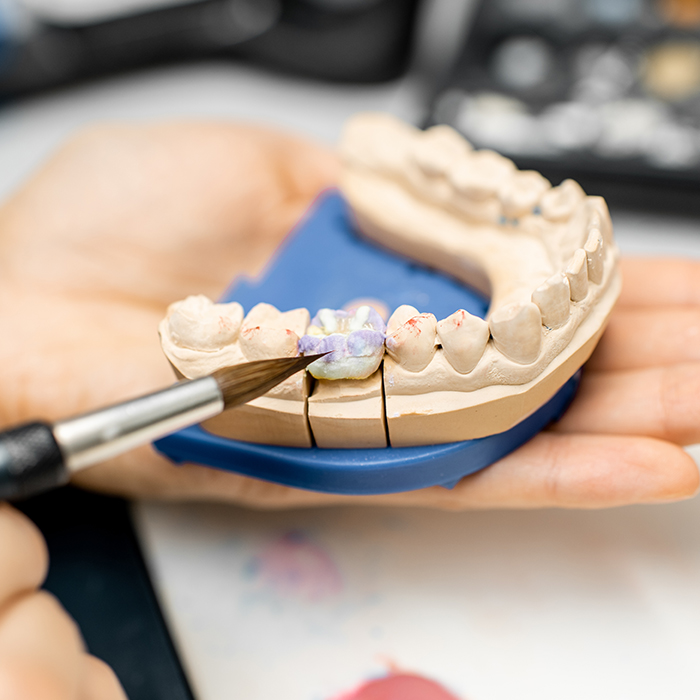
Metal-supported crowns
Artificial teeth can replace one or more missing teeth using different supporting frameworks, restoring function, appearance and speech. Regardless of the framework, the external restoration is made from porcelain.
Metal-supported porcelain crowns are a conventional option. Metal-free alternatives are also commonly used where appearance is particularly important. Metal-free porcelain may give better aesthetic results in the front of the mouth, while metal-ceramic restorations may be appropriate in posterior areas where appearance is less of a concern.

Complete dentures
Complete dentures are used when the patient has no remaining natural teeth. Upper dentures rely on suction and lower dentures on the balance of the tongue and cheeks. Without fixed anchorage, adapting to mouth movements takes time. Sore areas may develop initially; adjustments and continued use help the patient adapt.
- Should dentures remain in the mouth all the time?
The original clinic text describes wearing a new denture continuously for a few days as advised by the dentist to support initial adaptation. Afterwards, dentures should be removed for several hours daily, ideally at night, to allow the tissues to rest.
- Can I use denture adhesive?
The main concern with denture adhesive is inadequate cleaning and resulting infection. Adhesive may be used provided it is removed and renewed daily with appropriate cleaning.
Implant-supported complete dentures
Implant-supported dentures can address some difficulties associated with complete dentures. Implants stabilise the denture during chewing and speech while allowing removal when designed as a removable restoration. They may be smaller than conventional dentures and use special attachments to create a stable connection between the denture and implants.
Precision attachment dentures
Precision attachment dentures are used when several teeth are missing and fixed restorations are not possible. Hidden attachments fit into prepared sockets. One part connects to a crown on a supporting tooth and the other is concealed within the denture, providing improved appearance and stability.
Prosthodontics · Frequently asked questions
General patient information. Your examination determines diagnosis and the treatment suitable for you.
What is the aim of prosthodontic treatment?
It restores function and appearance when teeth are missing or badly damaged. Options include crowns, bridges, removable dentures and implant-supported restorations.
Are fixed or removable replacements more suitable?
The number of missing teeth, supporting teeth, bone and ability to clean are considered together. The same solution does not suit everyone.
Does adapting to a new denture take time?
Speaking and chewing may take practice, particularly with removable dentures. Have sore spots or persistent pain checked rather than adjusting it yourself.
Should removable dentures be taken out at night?
Usually yes, unless your dentist advises otherwise. Ask how to clean and store your particular denture.